Germany’s solar feed-in tariff turned a subsidy into a self-sustaining market. A new NatureFinance engagement brief examines whether insurance premium subsidies could do the same for climate adaptation. In this blog series, we pull out the brief’s key messages, starting with how premium subsidies can create an insurance virtuous cycle.
Key messages
• Brazil and Uganda show the same pattern: insurance uptake rises and falls almost in lockstep with subsidy budgets. A key binding constraint is subsidy size, and to a lesser degree farmer appetite for the product.
• Insurance is a proven climate adaptation tool, but remains severely underused in low and middle-income countries, where affordability constraints and rising climate risk are widening the insurance protection gap.
• Insurance premium subsidies can offer a promising solution for scaling insurance uptake, especially if they reward risk reduction rather than simply lowering cost.
Around the world, households, businesses and governments are facing a growing paradox. As climate and nature-related risks become more costly, insurance has never been more important. But in many places, insurance is becoming harder to afford and, in some cases, harder to obtain.
The challenge is already visible across sectors, but agriculture brings it into particularly sharp focus. In India, a weak and uneven monsoon has delayed the planting of rice, cotton, corn and soybeans, while in Brazil, unseasonal rain has disrupted coffee harvesting and increased the risk of crop losses. These are not isolated setbacks. When harvests fail, the effects ripple through food prices, export earnings, rural credit and public finances.
Insurance is one of the most effective tools available for absorbing climate shocks and supporting climate adaptation. In agriculture, it can mean the difference between a farmer replanting after a failed season and defaulting on a loan. Yet across many low and middle-income countries, insurance remains severely underutilised, with penetration rates often below 1% of GDP.
Insurance premium subsidies can help close that gap. Experiences from Brazil and Uganda show that they can expand insurance coverage, but only when they are well targeted and backed by predictable funding. Resilience-linked subsidies go further by rewarding actions that reduce physical risk, helping build stronger insurance markets while supporting long-term climate adaptation.
Why insurance remains out of reach
Low insurance uptake largely comes down to two things: affordability and behaviour.
Insurance is often simply unaffordable for those on low incomes. Spending tends to increase only once a country’s GDP per capita reaches around US$10,000, before leveling off as economies mature.
But affordability is only part of the story. Even when people can afford insurance, many still choose not to buy it. This reflects a familiar behavioural bias: a preference for holding onto money today rather than paying for protection against a loss that might never happen.
Governments face a similar dilemma. Paying an insurance premium for disaster risk transfer is an immediate and visible cost that must be justified in this year’s budget, while any payout is uncertain and may only arrive after the next election. As a result, both households and governments often invest less in insurance than would make sense over the long term.
The problem is getting worse, not better. As climate and nature-related risks increase, insurers are retreating from the highest-risk regions rather than expanding into them. In California, for example, average homeowner insurance premiums increased by 84% between the end of 2020 and March 2026 as insurers responded to rising wildfire risk.
This widens the protection gap, the difference between total economic losses and what is actually insured, leaving the most vulnerable even more exposed. The scale is stark, with global economic losses from natural catastrophes reaching $220 billion in 2025, yet only $107 billion was insured. Governments increasingly become insurers of last resort, often without the fiscal capacity to absorb repeated shocks. Fiscal pressures mount, borrowing costs rise, and the resources available for climate adaptation shrink, creating a vicious cycle that can ultimately contribute to sovereign debt distress.
What insurance can learn from solar’s feed-in tariff
One of the most promising ways to break this cycle is through insurance premium subsidies, where governments help cover the cost of insurance. The idea borrows from an unlikely source: Germany’s feed-in tariff for solar power, which guarantees producers a stable price for the electricity they generate. This predictability gave the solar industry the confidence to invest and scale, ultimately helping transform the global energy market.
The comparison is not exact, but the underlying logic is similar. In both cases, the private market can struggle to reach scale because initial costs are high and demand remains limited. When insurance is too costly, too few people buy it. Risk pools remain small, insurers have less data and prices stay high. A subsidy breaks that cycle by directly lowering the cost for consumers, while also giving insurers time to expand, scale and diversify coverage as well as price risk more accurately.
This creates a virtuous cycle: as subsidies bring in more customers, the pool of insured people grows larger and more diverse, which lowers prices and attracts even more customers. Ideally, this cycle builds enough momentum that the market becomes self-sustaining, at which point the subsidy can be phased out without demand collapsing.
Programmes in Brazil and Uganda show how powerful insurance premium subsidies can be in stimulating demand. In both countries, the biggest constraint has often been the size and predictability of the subsidy budget, rather than farmers’ willingness to buy insurance. But the deeper lesson is that simply making insurance cheaper is not enough. To strengthen resilience over the long term, subsidies need to reward risk reduction, not just insurance uptake.
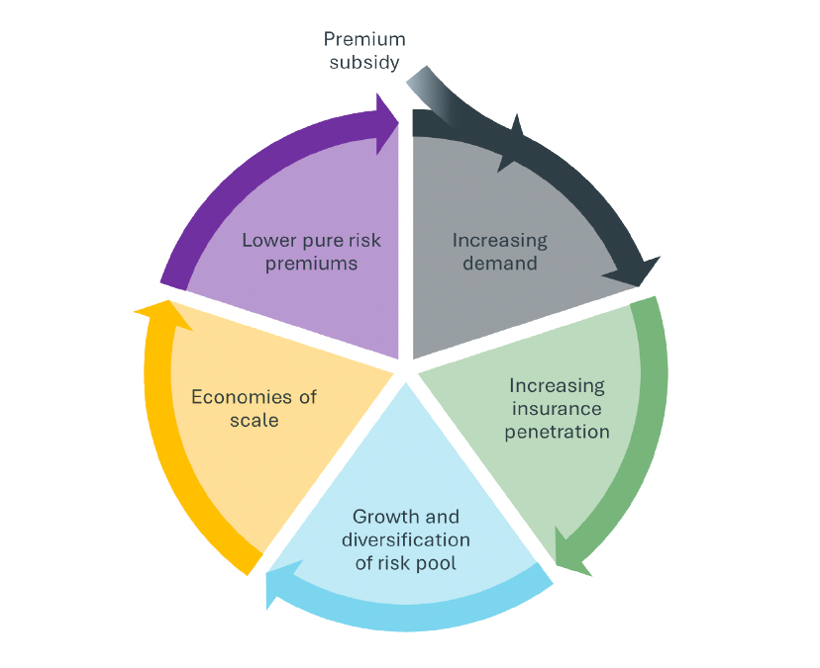
Insurance premium subsidy virtuous cycle showing how subsidies increase insurance uptake and strengthen climate resilience.
Brazil: redesigning subsidies for resilience
Brazil is home to some of the world’s largest agricultural operations, with individual farms often covering tens of thousands of hectares. But more than 4.7 million small and medium-sized farmers, who together account for the majority of the country’s food production, manage rising climate risk at a very different scale.
Brazil’s Rural Premium Subsidy Program has run since 2005, paying a share of the premium directly to private insurers on farmers’ behalf and has been instrumental in driving crop insurance uptake. Since the programme’s inception, funding and rural insurance uptake have moved closely together: the subsidy budget more than tripled between 2018 and 2021, and coverage rose in step before falling back after drought, softer commodity prices and repeated budget cuts. Even at its 2021 peak, coverage reached only around 5% of Brazil’s cultivated area, well below comparable US coverage, suggesting that subsidy size is a binding constraint.
But for much of its history, the support flowed almost entirely to large commercial farms growing soy and corn in the Midwest. Smallholders in the drier, riskier North and Northeast were largely left out, not by design, but because the type of insurance the subsidy funds simply isn’t sold in those regions.
This is why Brazil’s recent update to the subsidy scheme was considered pioneering. Recognising that a flat discount wasn’t reaching the small producers who needed it most, the government began piloting a performance-linked subsidy in 2024, tiered by crop and tied to sustainable land-use indicators.
Most crops now qualify for a 40% subsidy, rising to 45% for low-carbon practices, and higher still for strong performance on resilience measures like soil health, no-tillage and crop diversity. If it works as intended, promoting climate-smart practices that build long-term adaptation rather than just cutting costs, lower risk should eventually mean less need for the subsidy itself, a path Brazil has only just begun to test.
Uganda: subsidies expand access for smallholder farmers
Uganda offers a useful point of comparison. Agriculture is the country’s main source of livelihood, employing about 66% of the population and contributing 24.5% of GDP, making it central to food security.
Uganda’s Agriculture Insurance Scheme, launched in 2016, took a different approach to the same problem Brazil faced. Rather than a flat subsidy rate, the government covers 30% of premiums for larger farmers, 50% for smallholders, and 80% for producers in high-risk regions, providing greater support to those least able to absorb the unsubsidised cost.
The scheme also relies heavily on parametric, or index-based, insurance, which pays out automatically when a measurable trigger, such as rainfall falling below a set threshold, is reached, rather than requiring an assessor to inspect the damage in person. This makes it far cheaper to insure Uganda’s many smallholders growing multi-harvest crops like coffee, bananas and cassava, where individually assessing each small plot would not be economical.
The results have been striking. Coverage grew nearly seventeen-fold in seven years, from 45,700 farmers in 2017 to 772,000 by 2024, and the government has set a target of 3 million by 2027. Where Brazil’s scheme spent much of its history reaching large commercial farms, Uganda’s steeper, targeted subsidy rates have done exactly what they were designed to do: bring in the smallholders that conventional insurance markets overlook.
The ceiling on ambition is funding, not demand. The annual subsidy bill, around US $1.3 million, is less than 1% of Uganda’s wider agro-industrialisation programme budget, and plans to triple it remain unconfirmed. Reaching 3 million farmers by 2027 from fewer than 800,000 would mean scaling coverage roughly fourfold on a budget not yet sized to match.
Insurance subsidies must be well designed and consistently funded
The experiences of Brazil and Uganda show that insurance premium subsidies can increase insurance uptake, but only when they are well designed and backed by predictable funding.
Poorly targeted schemes can distort incentives and mainly benefit larger policyholders who might have bought insurance anyway. Brazil’s experience illustrates this risk, with support historically concentrated among large soy and maize producers in the Midwest. Uganda shows the opposite design choice with higher subsidies for smallholders and producers in high-risk regions. But even a well-targeted scheme cannot scale without a budget large and stable enough to sustain it.
The real opportunity lies in resilience-linked subsidies that do more than reduce premiums. The next article in this series explores the design principles needed to make these schemes efficient, scalable and capable of strengthening insurance markets and long-term climate adaptation.