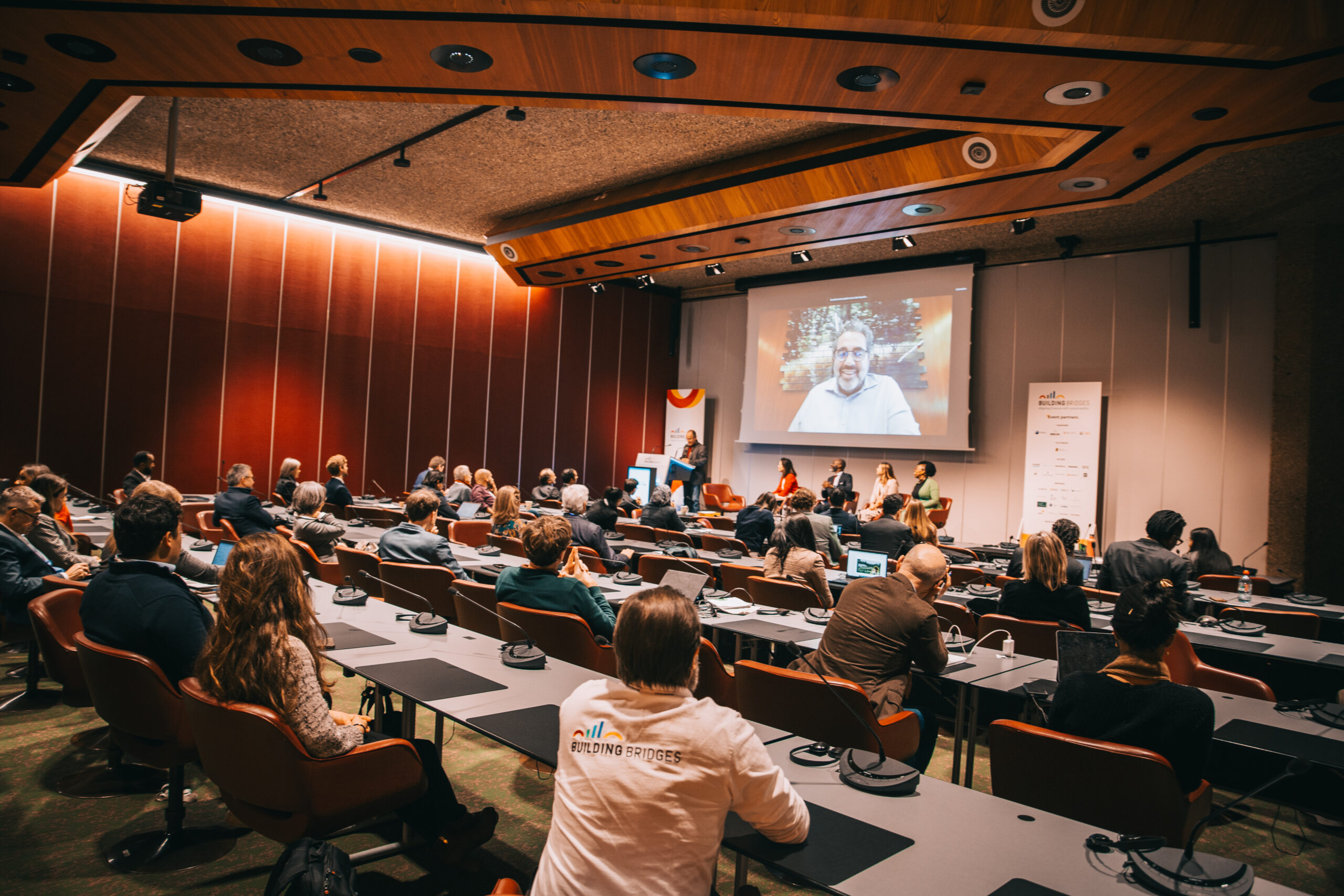
From 6 – 8 October, Building Bridges returned to Geneva for its seventh edition, bringing together leaders from finance, business, government and civil society to explore how financial systems can better support a sustainable economy.
This year’s discussions unfolded against a difficult backdrop of intensifying climate and nature-related risks, growing pressures on food and supply-chain resilience, shrinking aid budgets and mounting debt distress. These challenges made the economic importance of nature increasingly apparent, but also exposed the limitations of the systems meant to finance its protection and sustainable use.
NatureFinance co-organised, moderated and contributed to discussions on sustainable bioeconomies, nature-related risks, resilient infrastructure and the financing and policy changes needed to support nature-positive investment. Across these conversations, a common tension emerged: nature creates economic value in ways that our financial systems are not always designed to recognise or reward.
Here are five questions Building Bridges 2026 left us asking about what needs to change.
1. Are we collecting more nature data without changing financial decisions?
“Ecological risk and economic risk are the same thing at this point in time,” observed NatureFinance CEO Julie McCarthy.
Yet nature loss remains largely absent from balance sheets, risk pricing and national budgets, despite its implications for economic activity and asset values.
The problem is not necessarily a lack of information. John Willis, Senior Director at the World Business Council for Sustainable Development, highlighted that global food-products corporation Danone reports 2,000 sustainability metrics across 25 frameworks. This raises an important question about whether expanding disclosure requirements is helping financial institutions make better decisions, or simply creating more reporting.
What matters is whether nature-related information changes how risk is assessed and capital allocated. Natural capital accounting can help make ecological dependencies visible in national statistics, while new approaches to sovereign risk analysis are beginning to show how investments in resilience can be reflected in the economic growth and debt projections that inform financial decisions.
The real test of better nature data is not how much we disclose, but whether it changes investment decisions, public budgets and the price of risk.
2. Why do we apply different standards to natural and engineered infrastructure?
Consider two forms of coastal protection: a concrete seawall and a mangrove forest. One generally depreciates over time; the other can strengthen its protective function as it grows. Both provide infrastructure services, yet natural and engineered infrastructure are rarely evaluated and financed as part of the same system, even when nature-based approaches offer more cost-effective solutions.
The evidence for nature’s protective value is becoming more concrete. In Portugal, AXA Climate modelling suggested that well-maintained firebreaks could reduce insurance premiums by up to 78%, compared with just 5% if they were not maintained.
The difference matters. Natural infrastructure requires ongoing management, just as engineered infrastructure does. But its benefits often take the form of avoided losses, are shared across multiple beneficiaries and vary according to local ecological conditions. These characteristics make it harder to finance through models built around predictable revenue streams.
As Marco Serena of the Private Infrastructure Development Group argued, “Stop thinking about infrastructure as a grey thing; think about it as a service.“
If infrastructure is valued for the protection and services it provides, natural systems should be assessed alongside engineered alternatives, with comparable attention to performance, maintenance and long-term value.
3. Are we overlooking the foundations needed to make nature-positive investment possible?
A shortage of investable opportunities was a recurring concern at Building Bridges. But focusing on bankability alone risks overlooking what makes businesses and projects investable in the first place.
Nature-positive enterprises often need patient capital, technical assistance and reliable buyers long before they can attract institutional investment. As Akim Daouda of Mwaana Inc. put it, “Before one to five, you need zero to one.” This is precisely the gap that initiatives such as the Green Accelerator, launched at Building Bridges, aim to address to help turn promising opportunities into bankable investments.
The African bioeconomy discussions exposed another problem: conservation investors may finance production and land stewardship but avoid processing, while commercial investors support processing but hesitate to finance primary production. The businesses connecting these stages can therefore fall between different pools of capital. This financing gap is particularly relevant to Africa’s agricultural sector, where moving from primary production to higher-value bioeconomy activities requires investment across the entire value chain.
Bridging that divide requires more than aggregating projects into larger portfolios. It means strengthening the processors, offtakers and smaller enterprises that connect producers to markets, while using public policy, guarantees and project preparation to create viable investment opportunities.
Rather than asking only how to make individual projects bankable, we should ask how to build the markets and institutions that allow nature-positive businesses to thrive.
4. How do we ensure the bioeconomy doesn’t reproduce the inequalities it promises to address?
The sustainable bioeconomy offers opportunities to create prosperity from renewable biological resources. But unless its development is deliberately shaped, it risks reproducing familiar patterns in which resources are extracted locally while most economic value is captured elsewhere.
Africa supplies around 90% of the world’s traded raw cashews, yet processes less than 15% locally. This illustrates how much value can be lost when countries participate primarily as suppliers of raw materials rather than processors, manufacturers and innovators.
Emerging opportunities involving genetic resources and digital sequence information raise similar questions about who has the scientific capabilities, commercial rights and investment needed to benefit from bio-based innovation. The Gila monster, whose venom inspired early weight-loss medicines, illustrates this imbalance: biodiversity can underpin billion-dollar industries, while much of the commercial value goes to those with the patents, technology and capital to develop it, rather than the local communities that protect and steward the species and ecosystems underpinning the discoveries.
Fair benefit-sharing is essential, but it is only part of the answer. Keeping more value where it originates means building the industries and capabilities to turn biological resources into higher-value products, supported by local processing capacity, technology, access to finance and meaningful participation by communities and rights holders.
A successful sustainable bioeconomy should not be judged only by its size, but by whether biodiversity-rich countries and the communities stewarding these resources have a greater role in creating and capturing its value.
5. Who should pay for resilience when its benefits extend beyond those financing it?
Nature-based resilience creates value across entire economies. Farmers restoring soils, communities protecting mangroves and businesses investing in healthier landscapes can reduce risks for supply chains, insurers, governments and consumers.
Yet those bearing the upfront costs are not always those receiving the greatest benefits.
This tension was particularly clear in discussions about insurance. While evidence that healthy ecosystems reduce physical risks is improving, insurance premiums can remain unaffordable for smaller projects and producers.
The challenge, therefore, is not simply to demonstrate that nature works, but to establish financing arrangements that recognise who benefits from the protection it provides.
Resilience-linked insurance premium subsidies offer one possible approach. By sharing premium costs among governments, value chain buyers and other beneficiaries, and linking support to measurable resilience outcomes, they could make insurance more affordable while rewarding practices that reduce future risk.
Such mechanisms must be carefully designed to avoid subsidising risky behaviour. But they address a fundamental mismatch: resilience generates collective benefits, while its costs are too often left with individual actors.
Financing resilience means finding ways to distribute its costs and rewards more fairly across those who depend on it.
What ties these questions together?
Across these five questions, a common challenge emerges: translating the economic value of nature into the decisions that shape investment. Doing so requires more than new financial instruments or better data. It requires governments, businesses and financial institutions to align their policies, incentives and investment approaches, so that nature-positive outcomes become part of mainstream economic decision-making rather than a separate consideration.
The coming months offer important opportunities to carry these conversations forward. The Global Bioeconomy Summit, CBD COP17 and COP31 will bring renewed attention to the links between nature, economic development and resilience. NatureFinance will carry the lessons from Building Bridges into each of them.
The challenge is not simply to mobilise more finance for nature. It is to build a financial system that recognises the value nature creates, responds to the risks of losing it and shares the benefits of protecting it.