The convergence of climate and nature shocks, commodity supply disruptions, and mounting sovereign debt pressures is exposing deep economic vulnerabilities around the world, particularly across the Global South.
As these pressures intensify, a sustainable bioeconomy offers a way forward, creating jobs and economic resilience, supporting more inclusive livelihoods, and protecting and regenerating nature.
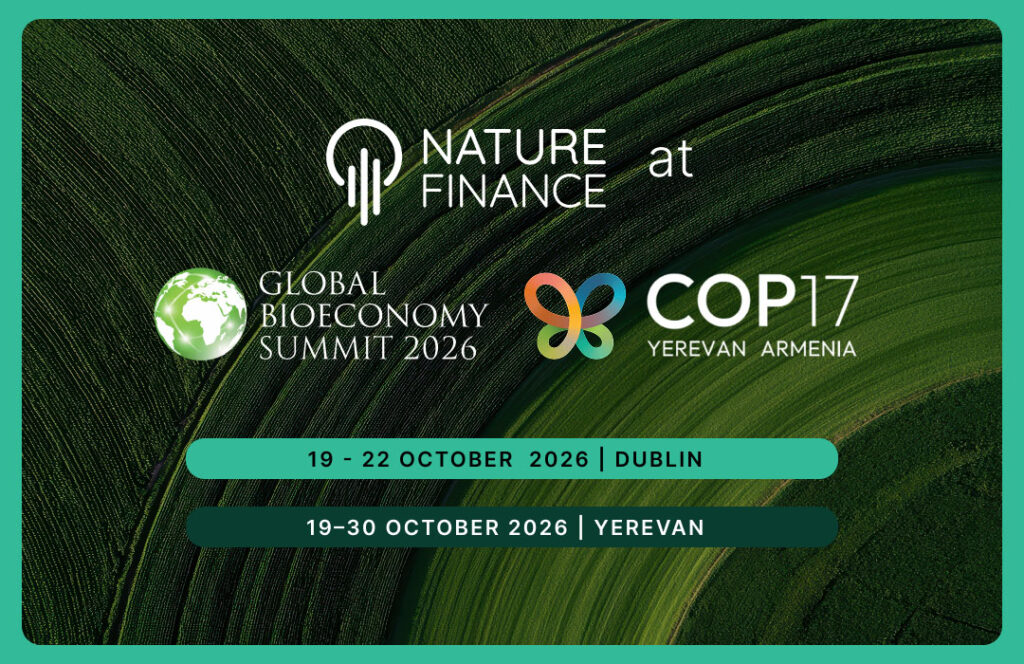
This October, two major moments for nature and the bioeconomy converge. The Global Bioeconomy Summit meets in Dublin on 20-21 October while the 17th Conference of the Parties to the Convention on Biological Diversity (CBD COP 17) runs in Yerevan from 19 to 30 October. NatureFinance will be at both, working with partners and exploring practical ways to scale a sustainable and inclusive bioeconomy, connecting local innovation with global finance and policy reform.
These discussions will also help shape the next steps for the Bioeconomy Challenge, whose Secretariat is hosted by NatureFinance. The initiative will present the first draft of the Global Bioeconomy Roadmap at COP31, marking its first anniversary.
Four priorities will shape our engagements across Dublin and Yerevan:
1. Making resilience count in sovereign finance
Debt sustainability analysis and credit ratings register the damage shocks cause, but give little weight to the investments that reduce it. With fertiliser supply disruptions and a super El Niño on the horizon, risks to food security, public finances and sovereign debt are converging, with the Global South particularly exposed.
Investment in locally made bio-based inputs is a clear example of resilience these systems overlook: it can reduce fertiliser import bills, ease pressure on foreign exchange reserves and help safeguard future harvests. If sovereign risk assessments recognised these gains, countries could borrow on better terms, turning resilience into a fiscal asset.
2. Strategic leadership for a competitive bioeconomy
Countries that process their own biological resources keep more of the jobs, revenue and resilience they generate. Yet, raw materials are often exported while the jobs and profits from processing them are captured elsewhere. Changing this requires strategic industrial and trade policies to build competitive bio-based industries and supply chains.
Governments can use procurement, incentives and trade policy to build markets for sustainable bio-based products, support domestic processing and expand market access for SMEs and community enterprises. Regional and South-South cooperation can strengthen these industries, expand trade and retain value for local producers and communities, while protecting nature.
3. From local action to systems change
Mobilising more finance is critical to unlocking the bioeconomy’s potential and enabling it to scale. From Southern Africa to the Pan-Amazon, the challenge is to build pipelines of bankable projects and move from thousands to millions and billions in capital. Many promising enterprises stall in the missing middle: too large for grants, but still too early or too risky for commercial investors.
NatureFinance is working with partners to bridge this gap through financing approaches grounded in local realities and adaptable across contexts. Through the African Bioeconomy Finance Hub and the Bioeconomy Challenge, we are connecting lessons from the ground with global work on finance, metrics and markets, helping build the conditions for investment at scale.
4. The bioeconomy as a pathway for the GBF
COP17 will conduct the first global review of progress towards the Global Biodiversity Framework’s 2030 targets, identifying gaps and priorities for action. This is an opportunity to position a sustainable bioeconomy as a pathway for delivering biodiversity commitments, while advancing climate and land restoration goals.
This requires embedding nature in economic and industrial transformation, from national biodiversity strategies to industrial policy and investment frameworks. As governments develop national and regional bioeconomy strategies, aligning them with biodiversity targets can advance GBF implementation alongside economic growth and job creation.
Where to find NatureFinance
Global Bioeconomy Summit | Dublin, 20-21 October
Beyond science and technology: Scaling the bioeconomy in the Global South
Tuesday 20th October | 11.15 – 12.45 | Wicklow Meeting Room 5
Convened by the Inter-American Institute for Cooperation on Agriculture, South Africa’s Department of Science, Technology and Innovation and the European Commission DG INTPA, this workshop will examine the policies, finance and partnerships needed to scale bioeconomy innovation, drawing on experience from Latin America and Africa. NatureFinance will lead one of three Scaling Action Labs.
Bioeconomy: Closing the scale-up gap between global frameworks and the ground level
Wednesday 21st October | 11.00 – 12.30 | Wicklow Hall 2A
Co-led by the Bioeconomy Challenge, NatureFinance and University College Dublin, this workshop will take stock of the initiative’s first year and draw on experience from the African Bioeconomy Finance Hub and the TRANSFORM project. Participants will draft recommendations to inform the next steps towards COP31.
People and biodiversity at the heart of the bioeconomy: from local territories to global impact
Wednesday 21st October | 11.00 – 12.30 | Ecocem – Speaker Ready Room
Co-organised by WRI Brasil, the Pan-Amazon Network for Bioeconomy, Embrapa, The Nature Conservancy and Uganda’s Natural Chemotherapeutics Research Institute, this workshop will draw on experiences from Uganda, Colombia and Brazil to explore how community-led bioeconomies can create local value, strengthen Indigenous and local livelihoods, and conserve biodiversity.
Read more about our workshops during the Global Bioeconomy Summit via the full workshop programme here.
CBD COP17 | Yerevan, 19-30 October
Unlocking Africa’s nature-positive bioeconomy: Mobilizing blended finance for infrastructure, value creation, sustainable development and shared growth
Thursday 22nd October | 17:00-18:15 | MDB Pavilion
Co-hosted by NatureFinance, the African Natural Capital Alliance and FSD Africa, this session will look at the infrastructure and development finance needed to grow Africa’s bioeconomy value chains. It will draw on the African Bioeconomy Finance Hub’s three priority areas: Regenerative Land Economies, the Blue Bioeconomy, and Data-Driven Biology and Innovation.
Trade, biodiversity and climate in a changing world order: unlocking competitiveness, regional integration, and market access for biodiversity-based products and services
Wednesday 28th October | 18:15-19:45 | Spitak, Side-event Room 2
Co-hosted by NatureFinance, Brazil’s Ministry of Environment and Climate Change, UN Trade and Development (UNCTAD), the World Trade Organization (WTO), the Bioeconomy Challenge, the Stockholm Environment Institute and the Ellen MacArthur Foundation, this official COP17 side event brings together governments, development finance institutions and businesses to develop policy recommendations on market access for biodiversity-based products. More information.
From principles to practice: Delivering the Global Biodiversity Framework through a sustainable, inclusive and nature-positive bioeconomy
Thursday 29th October | 10:00-11:00 | MDB Pavilion
Convened by the Bioeconomy Challenge, this high-level dialogue will explore how the bioeconomy can help deliver the Global Biodiversity Framework. Drawing on the initiative’s four working groups, it will examine how governments can integrate the bioeconomy into national biodiversity strategies, development plans, industrial policy and investment frameworks.
Related resources
Read the recent article by our CEO, Julie McCarthy, on how the fertiliser shock links food security, debt and climate.
Read our blog, Africa’s bioeconomy already exists. The question is who captures its value, and our new report, Investing in Southern Africa’s bioeconomy, to see how keeping more value on the continent can build stronger industries, greater resilience and more jobs.
Explore our report: Growing a Sustainable Bioeconomy Through Trade and International Cooperation to learn how trade policy and international cooperation can help scale a sustainable bioeconomy.
Explore our report: Financing the Bioeconomy in the Pan-Amazon: Mapping Financial Mechanisms, Success Factors and Recommendations to discover the financial mechanisms supporting the sociobioeconomy and what helps them succeed.
Learn more about the African Bioeconomy Finance Hub and the Bioeconomy Challenge, and their work to scale investment and implementation.